Own the media path and the AI path
The same platform controls WebRTC sessions, SFU routing, media processing, model execution, recording, and application context, reducing boundaries between communications and intelligence.
Production AI and Private Infrastructure
Private real-time communications intelligence combining WebRTC and custom SFU media infrastructure with local speech, language models, RAG, recording, composition, and central or edge inference.
RelayIQ is the intelligence layer of the OPTIME-developed Project Relay communications family. Because OPTIME engineers both the real-time communications path and the private AI processing path, speech, meeting, search, privacy, and workflow functions can operate directly alongside live media inside customer-controlled infrastructure.
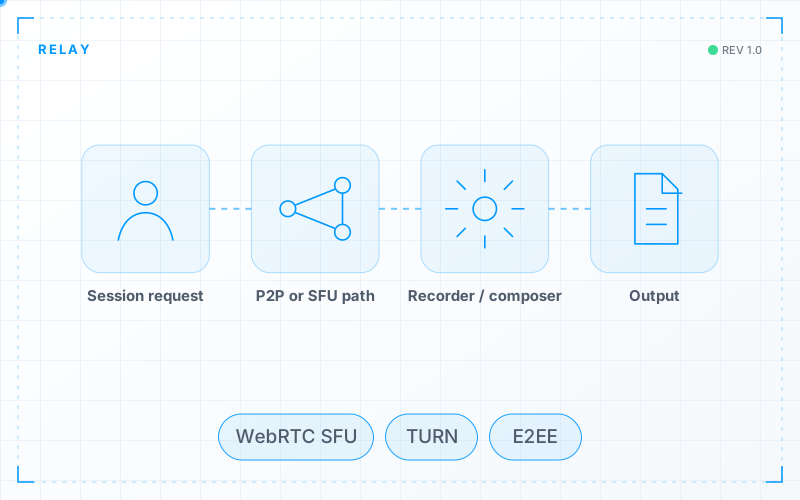
Participants and devices connect through WebRTC and custom signaling to a custom selective forwarding unit. GStreamer, NVIDIA DeepStream, and nvinfer connect selected live media to local speech, video, and language-model processing rather than requiring every communication stream to be sent to unrelated public AI services.
The platform supports different deployment boundaries. NVIDIA L40S serves central private or on-premises environments and larger aggregate workloads. NVIDIA Jetson Thor T5000 supports distributed edge deployments, while L40S can also serve larger edge installations. Storage and retrieval can remain local or connect to customer-selected external pgvector and S3-compatible infrastructure.
RelayIQ is not a separate customer engagement or a second 20-engineer program. Approximately 20 engineers contributed across the broader Relay product family over roughly six years; those contributors were not assigned exclusively to RelayIQ.
OPTIME owns the communications, media, recording, composition, storage, and AI integration layers needed to make intelligence part of the platform rather than an external afterthought.
Project Relay demonstrates the multi-tenant communications platform. Project RelayIQ demonstrates the speech, language, retrieval, and communications-intelligence layer built on that same foundation.
Users join calls, meetings, and communications workflows through the Relay application layer.
Custom signaling establishes sessions and connects participants to the platform’s custom SFU.
The media layer routes live participant streams while preserving session and tenant context.
Selected media is ingested for local speech, video, and inference processing.
Primary local transcription uses Parakeet-TDT; Whisper supports optional multilingual speech recognition.
Language, voice, retrieval, and workflow functions operate with meeting and communication context.
Separate participant tracks are retained and can be recombined by FFmpeg-library-based software into requested layouts.
Local storage and pgvector can be complemented by external pgvector and S3-compatible stores chosen by the customer.
L40S supports central and higher-capacity deployments; Jetson Thor T5000 supports compact distributed edge operation.
The same platform controls WebRTC sessions, SFU routing, media processing, model execution, recording, and application context, reducing boundaries between communications and intelligence.
L40S targets central private infrastructure and larger aggregate workloads; Jetson Thor T5000 targets smaller distributed deployments, with L40S also available for higher-capacity edge sites.
Recording individual tracks retains evidence for speaker-level analysis, archival, quality workflows, and later recomposition instead of collapsing all media at capture time.
Local pgvector and file storage provide a customer-controlled baseline, while external pgvector and S3-compatible systems remain available when the chosen architecture requires them.
The broader Relay program established multi-tenant communications, media, recording, composition, and storage foundations before and alongside the intelligence layer.
RelayIQ extends that foundation with representative capabilities including live transcription, multilingual speech processing, translation, meeting summaries, action items, semantic search, RAG, and live privacy checking. Additional workflows are intentionally omitted.
The platform combines custom WebRTC/SFU infrastructure with local speech and language processing, RAG, recording, composition, storage, and customer-controlled deployment options.
Primary local speech recognition uses Parakeet-TDT, with optional Whisper for multilingual use. Llama 3.1 supports communications and meeting intelligence, while TTS provides voice output without naming an unverified public model.
 P2P + SFU platformRelay - Multi-Tenant Communications and Collaboration Platform
CONTACT US
Austin, Texas
Distributed engineering teams across North America, Europe, the Caucasus, and Latin America.
[email protected]