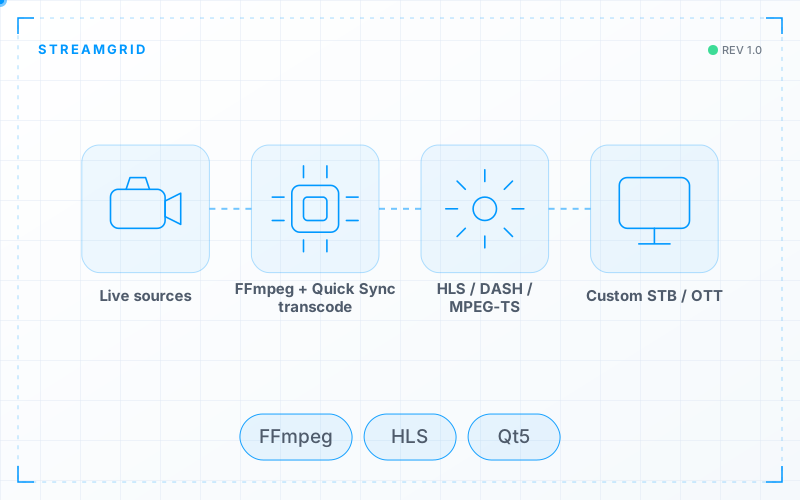
Engineer complete live and on-demand media platforms across operator networks, internet delivery, set-top boxes, smart TVs, browsers, mobile applications, and resource-constrained playback environments.
A dependable media platform connects ingest, processing, transcoding, packaging, delivery, playback, subscriber systems, recording, telemetry, and operations as one observable system. OPTIME engineers that complete path while preserving the network, device, and commercial systems that already matter.
Device, subscriber, quality, and operational integration
THE COMPLETE MEDIA PATH
A media service is only as strong as its complete ingest-to-playback path
A stream that plays in one laboratory client does not establish a usable service. The same content may need to cross a managed multicast network, an internet connection, a regional delivery layer, and devices with different codecs, browsers, decoders, memory limits, and release cycles. Each path changes how startup, buffering, channel switching, latency, and recovery must be engineered.
Media platforms also become fragmented when encoding, packaging, delivery, applications, subscriber services, recording, and monitoring are purchased or developed as isolated subsystems. A failure that appears in the player may begin with an ingest discontinuity, an encoder decision, a manifest update, an entitlement response, or a network transition. Without correlated telemetry, teams see symptoms but cannot follow the session through the platform.
Timeshift, catch-up, pause, rewind, recording, and indexed playback add state across backend and client systems. Modernization is therefore rarely a clean replacement. Operators often need to introduce OTT delivery, new codecs, software processing, or new applications while established channels, devices, subscriber workflows, and commercial obligations continue to operate.
The architecture must preserve media timing and service behavior from the source through the device-not only produce a valid output stream.
WHY SIMPLE IMPLEMENTATIONS FAIL
Device, network, media, and platform constraints interact
The most persistent service problems usually cross more than one subsystem.
Playback environments are not equivalent
Set-top boxes, smart TVs, browsers, and mobile applications have different decoder support, memory, security models, application runtimes, and update lifecycles. A common service still needs device-aware packaging, playback, telemetry, and fallback behavior.
IPTV and OTT use different delivery assumptions
Managed multicast can provide controlled distribution while internet delivery must tolerate variable bandwidth, unicast scale, cache behavior, and changing network paths. Combining them requires shared service logic without pretending the transports behave the same way.
Quality symptoms appear far from their cause
Startup delay, buffering, drift, channel-change time, or visual artifacts can originate in ingest, timestamps, encoding, packaging, origin capacity, delivery, entitlement, or device behavior. Isolated dashboards make those dependencies difficult to investigate.
Replacement can create more risk than value
A complete platform replacement may disrupt working subscriber, device, billing, protection, and operational systems. A phased architecture needs explicit compatibility boundaries, migration telemetry, rollback, and a period in which old and new paths coexist.
THE COMPLETE SOLUTION
Connect media processing, delivery, playback, and operation as one platform
OPTIME engineers the service boundary from live channels and files through ingest, normalization, transcoding, packaging, origin, distribution, recording, playback, subscriber controls, and operations. The implementation may modernize one constrained subsystem or establish a shared platform across managed IPTV and internet OTT delivery.
Processing decisions follow the channel count, codec and quality requirements, latency, hardware, redundancy, and operating cost. Client decisions follow the actual device matrix and product behavior. The control plane connects content, sessions, entitlement, subscriber state, protection, recording, and telemetry so the platform can explain what happened to a particular stream and viewer session.
Deterministic media handling remains separate from optional intelligence. AI-assisted search, metadata, or operations can be connected where useful, but it does not replace timestamp handling, codec correctness, manifest integrity, entitlement, playback state, or operator control.
ENGINEERING CAPABILITIES
The layers required for a dependable multiscreen media service
Each engagement uses only the layers required by the existing platform and intended service.
Content ingest and media normalization
Accept approved live feeds, files, schedules, and upstream services while preserving stream identity, timestamps, language, captions, metadata, and error state. Demultiplexing, validation, normalization, and discontinuity handling create a stable boundary for downstream processing.
Live and file ingest
Timestamp and metadata preservation
Input validation and recovery
Transcoding, encoding, and accelerated processing
Design codec, resolution, frame-rate, audio, and bitrate ladders around content, devices, bandwidth, quality, latency, and capacity. CPU, GPU, media engines, or other accelerators are selected through representative measurements rather than assumed from peak specifications.
Codec and ladder design
CPU and accelerator integration
Quality and capacity measurement
Packaging, origin, recording, and time-shift services
Coordinate segments, manifests, origin behavior, live windows, recording, pause, rewind, catch-up, and retention. State and timing must remain consistent across processing, storage, service APIs, and players during normal operation and recovery.
Live and on-demand packaging
Recording and catch-up
Origin and storage behavior
IPTV, OTT, multicast, unicast, and distribution integration
Connect managed-network and internet delivery without obscuring their different capacity, latency, reliability, and observability characteristics. Distribution may include multicast, unicast, CDN, regional, or edge paths with explicit failover and service policy.
Managed IPTV distribution
Internet and CDN delivery
Regional and hybrid paths
Set-top boxes, smart TVs, web, and mobile playback
Build or modernize player and application behavior across constrained set-top boxes, television platforms, browsers, and mobile devices. Startup, channel change, adaptive playback, buffering, security, telemetry, and update behavior are tested against the supported device matrix.
Device application integration
Playback-state engineering
Resource-constrained optimization
Subscriber, entitlement, billing, protection, and platform integration
Integrate identity, subscriber products, entitlements, sessions, billing, content protection, catalog, schedules, and operational APIs. Existing systems remain authoritative, with explicit failure and retry behavior at the media-service boundary.
Subscriber and entitlement services
Protection and session controls
Commercial-system integration
Quality telemetry, capacity, observability, and lifecycle operation
Correlate source, processing, packaging, delivery, application, device, and subscriber telemetry. Operators need service-level views, per-session evidence, capacity headroom, release validation, alarms, and runbooks that support investigation and controlled change.
End-to-end playback telemetry
Capacity and failure evidence
Release and operating controls
PLATFORM ARCHITECTURE
Follow content from its source to the viewer and back through telemetry
The layers are connected by media timing, service identity, control state, and observable operating behavior.
0107
1
Live channels, files, and upstream sources
Contribution feeds, live channels, assets, schedules, captions, and metadata establish the content and service inputs.
2
Ingest, demultiplexing, validation, and normalization
Inputs are identified, checked, synchronized, demultiplexed, and prepared while timestamps and media meaning remain traceable.
3
Transcoding, packaging, recording, and origin services
Media is transformed into approved formats, renditions, manifests, live windows, recordings, and on-demand assets with controlled state and recovery.
4
Managed-network, internet, CDN, and regional distribution
Multicast, unicast, cache, origin, regional, and edge paths deliver the service according to network and availability requirements.
5
Set-top boxes, televisions, browsers, mobile devices, and applications
Players and product applications interpret the service, manage sessions and playback state, and report device-specific experience.
6
Subscriber, entitlement, billing, protection, and control services
Authoritative business and security services determine who may use which content and how sessions, products, and protected media are controlled.
7
Playback telemetry, infrastructure, monitoring, and operations
Cross-layer evidence connects viewer experience to media, network, compute, storage, capacity, release, and incident behavior.
PLATFORM DECISIONS
Select delivery and modernization patterns from the service constraints
Managed IPTV or internet OTT delivery
Approach A
Managed IPTV can use controlled network capacity, multicast, and operator-managed devices.
Approach B
OTT reaches internet-connected devices through adaptive unicast delivery and distributed origins or caches.
Selection considerations
Many services require both. Keep shared subscriber and product behavior while designing capacity, resilience, telemetry, and playback for each network path.
Centralized or regional processing
Approach A
Centralized processing simplifies platform ownership and capacity pooling.
Approach B
Regional processing can reduce transport demand, latency, or failure scope and support local service requirements.
Selection considerations
Compare source location, network cost, channel reuse, regional variants, resilience, operating staff, and the cost of duplicated capacity.
Software encoding or hardware acceleration
Approach A
Software processing can provide flexibility and a broad codec or filter ecosystem.
Approach B
Dedicated media engines or accelerators can increase density or reduce CPU demand for supported workloads.
Selection considerations
Measure required quality, latency, codec features, stream density, portability, failure behavior, and lifecycle support on representative content.
Complete replacement or phased modernization
Approach A
A new platform can simplify architecture when existing constraints cannot be isolated.
Approach B
A phased migration preserves working devices, subscriber systems, or delivery paths while selected subsystems change.
Selection considerations
Choose from business continuity, compatibility, test coverage, rollback, dual-operation cost, and the ability to establish stable interfaces.
REPRESENTATIVE SCENARIOS
How the platform can evolve
These scenarios illustrate engineering patterns and are not claims about specific customer deployments.
Adding OTT delivery to an existing IPTV service
Scenario
An operator has live channels, subscriber systems, and set-top boxes but needs web, mobile, and smart-TV delivery over the internet.
Engineering response
The architecture adds packaging, origin and distribution, multiscreen applications, internet-session policy, and correlated playback telemetry while reusing approved ingest, content, subscriber, and entitlement services.
Resulting system behavior
The service supports managed and internet delivery through explicit network-specific paths without duplicating the complete commercial platform.
Modernizing processing without replacing every subsystem
Scenario
An established transcoding, packaging, or playback component limits codec support, capacity, observability, or product change.
Engineering response
OPTIME defines a stable interface, proves the critical media path, introduces the replacement alongside the current component, and validates stream, device, subscriber, telemetry, and rollback behavior.
Resulting system behavior
The constrained subsystem can change while the surrounding service continues through a controlled migration.
One service across set-top boxes and consumer devices
Scenario
A media product must provide consistent channels, recording, catch-up, and playback across operator devices, smart TVs, browsers, and mobile applications.
Engineering response
Shared service APIs and media policy are combined with device-specific playback, capability detection, packaging, application lifecycle, and telemetry.
Resulting system behavior
Users receive a coherent service while each device remains inside its actual codec, memory, security, and release constraints.
ENGAGEMENT APPROACH
Move from the existing media path to a validated platform change
Prove the most difficult channel, processing, packaging, network, protection, and device path under representative quality and timing conditions.
Possible deliverables
Critical-path implementation
Quality and latency baseline
Architecture decisions
3
Phase 3
Platform implementation or migration
Build or integrate the approved processing, delivery, application, subscriber, recording, and telemetry components with controlled coexistence and rollback where needed.
Possible deliverables
Production components
Integration and migration plan
Deployment automation
4
Phase 4
Capacity, playback, and operational validation
Validate concurrency, stream capacity, device behavior, network variation, failures, recovery, upgrades, monitoring, and support ownership before wider release.
Possible deliverables
Capacity and playback evidence
Failure and recovery results
Runbooks and knowledge transfer
POSSIBLE DELIVERABLES
Engineering outputs aligned with the selected service boundary
Media and delivery architecture
A defined path across sources, processing, packaging, recording, distribution, clients, subscriber services, telemetry, and operational ownership.
Processing and packaging implementation
Approved ingest, transcoding, packaging, origin, recording, time-shift, and control components with deployment and validation support.
Playback applications or device integrations
Set-top-box, smart-TV, browser, mobile, or embedded playback behavior connected to the shared service and device constraints.
Subscriber and platform integrations
Identity, entitlement, billing, protection, catalog, session, and operational interfaces with explicit error and recovery behavior.
Latency, quality, capacity, and operational evidence
Video Service Provider Platforms & Subscriber Experience
Build or modernize the subscriber, commercial, discovery, support, localization, application, and service-quality layers around a complete video service.
Build real-time video intelligence and multimodal AI for live and recorded video, audio, speech, images, captions, and stream metadata across analysis, search, indexing, recording, and playout.
Modernize professional live-media workflows with software-defined processing, routing, monitoring, multiviewing, metadata, recording, automation, and controlled AI assistance.