Skip to Solution content

Media and Communications

Intelligent Broadcast and Live Media Operations

Modernize professional live-media operations across contribution, processing, routing, monitoring, multiviewing, recording, metadata, automation, and operator control.

Deterministic timing, signal continuity, media quality, failure behavior, and human control remain central when software processing and AI-assisted metadata enter a live operation. OPTIME engineers the signal path and operator workflow as one observable system.

  • Professional live-media paths

  • SDI, IP, compressed, and uncompressed workflows

  • Monitoring, multiviewing, recording, and control

  • Software processing with deterministic operation

LIVE OPERATION

Live-media modernization must preserve timing, visibility, and operational control

A live facility cannot pause while its architecture changes. Signals may cross SDI, IP, compressed, and uncompressed paths; processing may remain distributed across appliances, servers, accelerators, and control systems. Timing, synchronization, frame accuracy, jitter, and deterministic failure behavior still matter even when functions move into software.

Operators often monitor many feeds through separate routing, multiviewing, recording, alarm, and metadata systems. An issue may be visible in one system without the timing, source, configuration, or upstream evidence needed to act. Adding software processing without coherent telemetry can increase flexibility while making the live path harder to understand.

AI-generated captions, transcription, detection, or metadata can assist search and operation, but it must remain aligned to the media timeline and operator workflow. A plausible label that arrives late, loses its timestamp, or triggers an uncontrolled action is not a dependable live-media function.

Modernization succeeds when operators gain flexibility without losing deterministic media behavior or authority.

SYSTEM PRESSURES

The hard problems appear at subsystem boundaries

Active operations combine legacy and modern interfaces, timing domains, human workflows, and failure paths.

  • Appliances and interfaces remain isolated

    Dedicated processing, routing, control, monitoring, and recording systems may expose proprietary interfaces and separate state. Operators cannot easily follow a signal or configuration change through the complete path.

  • SDI and IP coexist during migration

    Facilities rarely change every source, router, monitor, and destination at once. Gateways, timing, buffering, monitoring, and control must support a period in which old and new paths remain operational.

  • Visibility does not scale with feed count

    Manual supervision across many feeds can miss timing, quality, silence, freeze, transport, or metadata events. Useful automation must prioritize evidence without taking control away from the operator.

  • Intelligence loses the live timeline

    Speech, vision, captions, and event metadata may be processed separately from media timestamps and recording state. Without alignment, the result cannot reliably support clipping, search, review, or operator action.

THE COMPLETE SOLUTION

Engineer the live signal path and the operator workflow together

OPTIME connects contribution, capture, transport, timing, processing, routing, conversion, composition, encoding, multiviewing, recording, metadata, quality telemetry, control applications, and infrastructure. The work can replace a bounded appliance function, establish a software-defined path, or integrate a broader live operation.

Signal state, configuration, alarms, media quality, and operator actions are made traceable across the path. Automation handles deterministic, approved behavior; human operators retain explicit override and recovery controls. Accelerated compute is selected from measured channel density, latency, format, quality, and resilience requirements.

Intelligence is integrated where it adds operational value: captions, speech, vision, searchable metadata, or event detection can support monitoring and review. The original media, timestamps, confidence, evidence, and operator decision remain available so the live operation never depends on an unexplained model output.
ENGINEERING CAPABILITIES

Media processing, control, and operation across the complete live path

Contribution, ingest, and transport integration

Integrate cameras, feeds, venues, files, contribution encoders, gateways, and approved transports while preserving source identity, timing, format, and error state. Buffering and recovery follow the actual network and live-production boundary.

  • Contribution and ingest
  • Transport and gateway integration
  • Source and error identity

Timing, synchronization, and media normalization

Coordinate clocks, timestamps, sync, frame and sample alignment, buffering, jitter behavior, and format normalization across SDI, IP, compressed, and uncompressed paths. Timing evidence remains visible through processing and monitoring.

  • Clock and timestamp handling
  • Jitter and buffering
  • Format and signal normalization

Processing, routing, composition, and conversion

Implement routing, scaling, conversion, composition, mixing, encoding, and other required media functions in software, accelerated systems, or integrated appliances. Control interfaces expose deterministic state and supported recovery behavior.

  • Video and audio processing
  • Routing and composition
  • Codec and format conversion

Low-latency multiviewing and monitoring

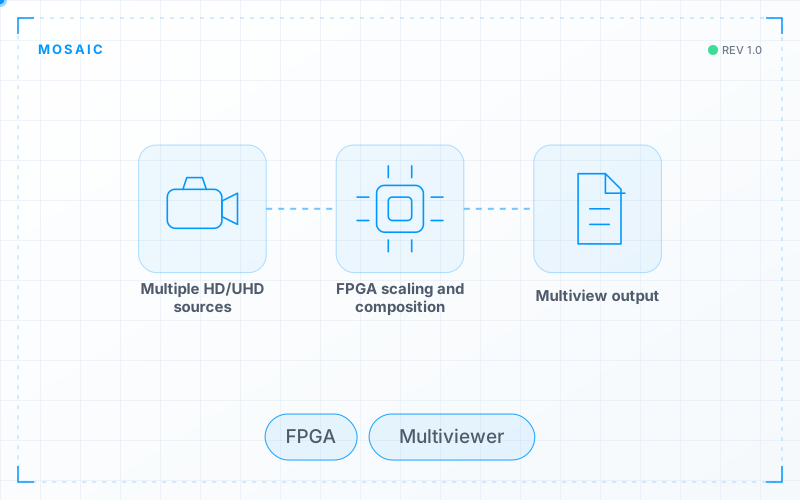
Build operator views that preserve feed identity, timing, labels, alarms, and media quality across many live sources. Layout, decoding, composition, and delivery are optimized for the required density and operator latency.

  • Multiview layouts
  • Signal and quality monitoring
  • Operator latency and density

Recording, review, clipping, and metadata

Connect continuous or event recording with synchronized transcripts, multimodal metadata, markers, review, clipping assistance, and searchable archive interfaces. Generated information remains traceable to the original signal and timeline.

  • Live and event recording
  • Searchable multimodal metadata
  • Operator-reviewed clipping workflows

Control applications, automation, and human override

Create control surfaces and APIs for routing, configuration, presets, events, and approved automation. Permissions, state, validation, alarms, manual override, and rollback remain explicit for live operators.

  • Operator control applications
  • Deterministic automation
  • Override and rollback

Accelerated infrastructure, resilience, and observability

Profile compute, GPU, FPGA, media engines, networking, storage, and synchronization around representative feed counts and failure domains. Cross-layer telemetry supports capacity, redundancy, incident investigation, and controlled upgrades.

  • CPU and accelerator capacity
  • Redundancy and failure domains
  • Cross-layer telemetry

Localization, privacy, and operator-reviewed AI

Integrate transcription, captions, translation, searchable content, and configured privacy transformations through private or edge AI where timing and data boundaries require it. Operators review model-assisted logging, clipping, metadata, and localization before consequential publication or control actions.

  • Transcription and localization
  • Privacy-aware media paths
  • Private and edge AI with operator review

LIVE-MEDIA ARCHITECTURE

Connect signals, intelligence, operators, and infrastructure

  1. Cameras, feeds, venues, and contribution sources

    Live and recorded sources establish the media, timing, location, and production context.

  2. Capture, transport, buffering, timing, and synchronization

    Gateways and transport paths preserve signal identity and control latency, jitter, clocks, timestamps, and recovery.

  3. Processing, routing, conversion, composition, and encoding

    Deterministic functions transform and direct media through software, accelerated, or existing processing systems.

  4. Multiviewing, monitoring, recording, and quality telemetry

    Operators and systems observe live feeds, record approved paths, and connect alarms or quality evidence to the media timeline.

  5. Speech, vision, captions, metadata, and event intelligence

    Optional intelligence creates time-aligned information that can support search, review, clipping, and operator decisions.

  6. Control applications, automation, operator actions, and override

    Approved state changes and workflows remain observable, permissioned, reversible where practical, and under human authority.

  7. Compute, acceleration, networking, resilience, and operations

    Infrastructure capacity, timing, failure domains, monitoring, deployment, and support make the complete system operable.

ARCHITECTURE DECISIONS

Modernize without applying one pattern to every live function

SDI and IP coexistence or complete migration

Approach A

A coexistence path uses gateways and shared control while established SDI systems remain active.

Approach B

A broader IP migration can simplify routing and software integration when timing, network, and operational readiness are established.

Selection considerations

Assess facility lifecycle, timing, compatibility, operator workflows, migration windows, redundancy, and the ability to validate both paths.

Appliance-based or software-defined processing

Approach A

Dedicated appliances may provide familiar, bounded functions and deterministic interfaces.

Approach B

Software-defined processing can improve flexibility, deployment, observability, and hardware choice.

Selection considerations

Compare latency, format support, density, failure isolation, control behavior, portability, lifecycle, and operational capability for each function.

Centralized or distributed operation

Approach A

Centralized processing pools capacity and can simplify platform management.

Approach B

Venue, regional, or edge processing can reduce transport, latency, or failure scope.

Selection considerations

Balance contribution bandwidth, timing, staffing, infrastructure duplication, remote control, resilience, and local continuity.

Deterministic automation or AI assistance

Approach A

Deterministic automation performs known actions from explicit rules and system state.

Approach B

AI-assisted workflows can interpret speech, vision, or events and recommend an operator action.

Selection considerations

Keep critical routing and recovery explicit. Use model assistance where evidence, confidence, timing, review, and operator authority can be preserved.

REPRESENTATIVE SCENARIOS

How live-media systems can evolve safely

These representative scenarios illustrate engineering patterns and are not completed-customer claims.

Moving appliance functions into software

Scenario
An active operation depends on isolated routing, conversion, processing, or monitoring appliances with limited integration and visibility.
Engineering response
The critical signal, timing, control, and failure path is reproduced in a software-defined component, integrated alongside the current function, and validated under representative formats, feed counts, and failover.
Resulting system behavior
Selected functions can migrate incrementally while operators retain familiar control, observability, and a controlled fallback path.

Low-latency monitoring across many feeds

Scenario
Operators need one consistent view of numerous live sources, alarms, labels, and quality state without unacceptable monitoring delay.
Engineering response
Ingest, decode, synchronization, GPU or media-engine composition, layout, telemetry, and operator delivery are profiled as one path.
Resulting system behavior
The multiviewer presents time-aligned feeds and actionable state within a measured density and latency envelope.

Adding searchable intelligence to live operation

Scenario
A facility wants captions, transcription, event metadata, clipping, or search without disrupting current signal processing and control.
Engineering response
Intelligence is attached to duplicated or approved media paths, aligned to timestamps, stored with evidence and confidence, and connected to review or clipping workflows.
Resulting system behavior
Operators gain searchable context while the deterministic live path and human control remain authoritative.

ENGAGEMENT APPROACH

Prove timing and failure behavior before changing the active operation

  1. Phase 1

    Live signal and control-path assessment

    Map sources, formats, clocks, transports, processing, routing, monitoring, recording, controls, operator actions, infrastructure, and failure requirements.

    Possible deliverables

    • Signal and control map
    • Timing and dependency assessment
    • Migration risks
  2. Phase 2

    Critical latency and failure-path proof

    Implement the most constrained media and control path and measure timing, quality, density, operator latency, and recovery on representative inputs.

    Possible deliverables

    • Critical-path proof
    • Latency and quality baseline
    • Failure findings
  3. Phase 3

    Production integration and migration

    Build and connect processing, control, monitoring, recording, metadata, and infrastructure components with coexistence and rollback where required.

    Possible deliverables

    • Production components
    • Control and telemetry integration
    • Migration automation
  4. Phase 4

    Operational, resilience, and quality validation

    Exercise feed loss, timing disturbance, infrastructure failure, overload, operator override, update, recovery, monitoring, and support ownership.

    Possible deliverables

    • Resilience evidence
    • Operational acceptance results
    • Runbooks and handoff

POSSIBLE DELIVERABLES

Outputs connected to the live-media boundary

Live-media system architecture

A defined signal, timing, processing, control, monitoring, infrastructure, and operating model.

Processing and routing components

Approved ingest, transport, conversion, composition, encoding, routing, and accelerated processing implementations.

Monitoring, multiviewing, or control applications

Operator experiences connected to live state, alarms, quality, permissions, override, and recovery.

Metadata and workflow integration

Time-aligned captions, speech, vision, events, recording, search, review, and clipping interfaces where required.

Latency, timing, capacity, and failure evidence

Representative measurements, acceptance criteria, resilience results, operating documentation, and ownership transfer.

Deliverables are selected from the current facility, migration boundary, and required operational outcome.

START A TECHNICAL CONVERSATION

Discuss the system, constraints, and engineering outcome.

Share the product, workload, architecture, infrastructure, performance, security, or delivery constraint that must be resolved.

Austin, Texas

Distributed engineering teams across North America, Europe, the Caucasus, and Latin America.

[email protected]

We use the information you submit to respond to your inquiry and process it through the service providers required to operate this form.